 |
Rosanne Bittner: Heart of the WestAdvice to Writers |
|
Rosanne Bittner: Heart of the WestAdvice to Writers |
|
In a nutshell -- Write what you love!!! Always write what you love!!! Do NOT write for the most popular genre. And be enthusiasitic about your story when presenting it to an editor or agent. Let your own excitement get him or her excited! Don't let a need for perfection slow you down. Just sit down and finish the book before you worry about editing. If you constantly stop to edit every single chapter before going on to the next, you’ll never finish the story and some of your enthusiasm for the story will fade. Never worry about a sagging middle or stop writing because you've come to an indecision about how to handle a particular situation. KEEP WRITING!! Even if it sounds stupid, if you write yourself “through” a particular rough spot, almost always it will come to you what you’ve done wrong or how you should “fix” the situation. I NEVER “PLAN” A STORY. I start a book and let it take me where it wants to go. I never fret over “what will happen?” or “how will I solve this particular situation?” It will solve itself as you write. You will have that light bulb “A-HA!”moment. As for the technical aspects -- first of all, find a special working space that's yours alone. That might be just a corner of the kitchen where you can sit undisturbed, or an extra bedroom that also doubles as your office.
Where do I get my ideas? Most come from research. Maintaining authenticity and keeping the flavor of the time period is very important to me; many readers have written to thank me for the "painless" history lessons contained in my stories. Conversely, if I make any type of error, my readers politely but firmly point them out to me. Over the past 40 years, therefore, I have collected a vast personal library of historical and reference books, and am a member of such organizations as: the Michigan Romance Writers, Oregon-California Trails Association, Western Writers of America, Women Writing the West, the Nebraska State Historical Society, and the Montana Historical Society. My husband and I also have traveled to most of the locales I write about so that I can get a "feel" for the settings. In turn, places I have visited and even seemingly minor footnotes in the history books have sparked "what ifs" for future books. As for characters--most pop to life from my imagination, but occasionally, a suggestion from a fan sparks an idea.
Most of all, you must be dedicated and determined. Don't give up, and good luck! For more of my own comments and insights on writing, you might be interested in reading these three articles: Please ... Just Write!! (before you can market your book, you first have to WRITE it!), Religion In Secular Fiction vs. The Inspirational Romance, and The Power of Passion, a three-part article which was adapted from a workshop I gave in 2012. You will also find a list of many helpful blogs I have written, with links to them, on my Articles pages! I am also honored to have been interviewed on 28 July 2014 for Romance Books 4 Us. You can read that interview here! |
|
"Rosanne, I want to thank you for the pleasure that your book gave me. It was that kind of book that a person finds hard to put aside even when your wife is calling you to supper." -- Arthur, 81 years young |
PLEASE NOTE: Because I am so busy with my own writing schedule, I no longer have the time to accept other manuscripts for critiquing.
Here's a Complete List of All
My Books  Here's How To Get Them
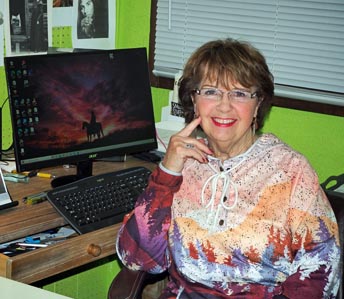 I am frequently asked
how I got started writing. Well, I couldn't NOT write. I have so
many stories to tell, I have to write! The entire process can
seem overwhelming to beginners, though. Here are a few tips for those of you
who have stories of your own to tell but need a little help getting them down
on paper.
I am frequently asked
how I got started writing. Well, I couldn't NOT write. I have so
many stories to tell, I have to write! The entire process can
seem overwhelming to beginners, though. Here are a few tips for those of you
who have stories of your own to tell but need a little help getting them down
on paper. Never give up! First and
foremost, you must write every day! When I started writing seriously in
1979, I was secretary to the manager of a nuclear power plant, wife, and mother
of two growing sons. "Free" time was severely limited, so I traded
sleep for hours at the typewriter-- yes, typewriter! Computers were rare when I
started writing. Now that I have established myself as a writer and can pursue
it full-time, I am usually up by 5:00 a.m. and write until noon, then more from
2:00 - 4:00, and often from 8 pm to 10 or 12 pm, including weekends. No days
off when I am working on a book!
Never give up! First and
foremost, you must write every day! When I started writing seriously in
1979, I was secretary to the manager of a nuclear power plant, wife, and mother
of two growing sons. "Free" time was severely limited, so I traded
sleep for hours at the typewriter-- yes, typewriter! Computers were rare when I
started writing. Now that I have established myself as a writer and can pursue
it full-time, I am usually up by 5:00 a.m. and write until noon, then more from
2:00 - 4:00, and often from 8 pm to 10 or 12 pm, including weekends. No days
off when I am working on a book!  When you have a
completed, polished manuscript in hand, it's time to contact a publisher or
agent (I sold my first 15 books without an agent.). Familiarize yourself with
the market, write to the various publishers for their tip sheets and authors'
guidelines, and go for it! Don't let rejections get you down. I collected 100
rejection slips for my first nine novels before I made my first sale. But, when
I was rejected, I got mad, not discouraged. I thought, "This is a good
story. Somebody is going to want it." Perseverance paid off in 1982
when I made my first sale, Sweet Prairie Passion, my ninth
manuscript which became Book #1 of my
When you have a
completed, polished manuscript in hand, it's time to contact a publisher or
agent (I sold my first 15 books without an agent.). Familiarize yourself with
the market, write to the various publishers for their tip sheets and authors'
guidelines, and go for it! Don't let rejections get you down. I collected 100
rejection slips for my first nine novels before I made my first sale. But, when
I was rejected, I got mad, not discouraged. I thought, "This is a good
story. Somebody is going to want it." Perseverance paid off in 1982
when I made my first sale, Sweet Prairie Passion, my ninth
manuscript which became Book #1 of my